In the high-stakes economy of today, the cost of a friction-heavy interface is no longer just “lost clicks”, but potentially millions in wasted engineering spend and lost business value. As a veteran UX designer who has helped build digital products since the early mobile-first era, I’ve watched business leaders shift from viewing design as a “cosmetic preference” to recognising that user experience is actually the primary engine of business survival.
A UX design role is as much about research and analytics as it is about pixels, and I believe that hard data is the only tool powerful enough to bridge the gap between design and the boardroom. Facts don’t just advocate for the user; they prove that UX is a non-negotiable requirement for a healthy bottom line. Even in the rooms where decisions are made, UX is frequently undervalued as a ‘visual’ role. I’ve learned that the most effective way to dismantle this myth is through data.
The following ten facts represent the current reality of the digital world. These are not just “design tips”; they are the clinical, data-backed pillars for financial growth in a saturated market. Some of these facts are also commonly used by designers as best practices.
For example, I once led a B2C mobile design project, where I was able to strip 1.2 seconds off the mobile load time by reducing and removing some of the visual assets. The result was an immediate 12% lift in completed transactions, proving that in UX, every tenth of a second is a direct lever for revenue.
1. Fixing Issues In The Design Phase Is 100 Times Cheaper
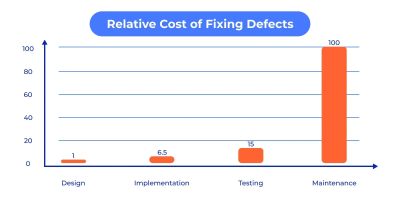
One of the most compelling financial arguments for UX is the 1:100 rule. Modern studies, such as from the IBM Systems Institute and Sugue Technologies, show that fixing an error after a product has been developed and launched can be up to 100 times more expensive than fixing it during the initial design and prototyping phase.
Think of UX as “engineering insurance.” By the time a developer touches the code, every interaction should have been validated. If you discover a fundamental navigation flaw after launch, you aren’t just paying for the fix; you’re paying for technical debt, lost developer time, and the revenue lost while users struggle with a broken flow.

2. Performance Impacts User Experience
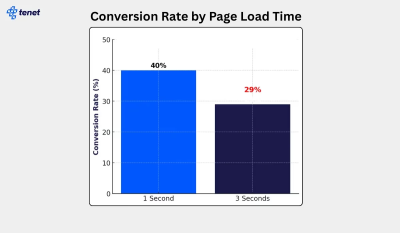
In the current landscape, performance is the essential foundation of user experience. A beautiful interface is worthless if the user bounces before it renders. The data is uncompromising: 47% of users expect a page to load in two seconds or less, and missing this window is a financial catastrophe. A mere one-second delay can reduce conversions by 20% and satisfaction by 16%, while retail businesses lose an estimated $2.6 billion annually to slow load times. When mobile load time moves from one to three seconds, the bounce rate spikes by 32%, and by the third second, conversion rates typically plummet from 40% to 29%.
However, this volatility offers a massive lever for growth. Even a microscopic 0.1-second improvement can lift retail conversions by 8.4%, and travel site conversions by 10.1%. Improving your Largest Contentful Paint (LCP) by 31% — a benchmark 67% of websites achieved as of June 2025 — can drive a direct 8% increase in sales. As a long-time designer, I treat speed as a primary design element.
If the site isn’t instantaneous, the design hasn’t just failed — it effectively doesn’t exist.
3. Your Site Has 50 Milliseconds to Impress Your Customers
First impressions are both visceral and aesthetic. Research indicates that users form an opinion about a website’s visual appeal in approximately 50 milliseconds (0.05 seconds). That’s not a lot of time! This split-second “gut-feeling” is a survival mechanism that dictates whether a user stays to explore your value proposition or bounces immediately.
In the current market, 94% of first impressions are strictly design related. If your interface feels “off” or dated, users subconsciously project that lack of quality onto your entire product or service. Your content effectively doesn’t exist if your design hasn’t earned the five seconds of attention required to read it.
4. Hick’s Law: The Cost of Overwhelm
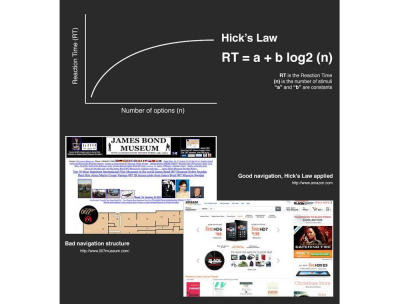
Stakeholders often think “more options” equals “more value.” Psychology proves the opposite. Hick’s Law states that the time it takes to make a decision increases with the number of options available.
Every extra menu item or form field is a “tax” on the user’s brain. As noted by Landbase, top-performing sites now achieve conversion rates exceeding 11%, while average performers struggle below 3%. Those performing well have applied personalization and optimization strategies to simplify the experience.
If you want to increase your revenue by tomorrow, find one field to delete from your checkout flow today.
5. White Space Improves Comprehension
“White space” is often viewed as wasted real estate by non-designers. In reality, it is a tool for focus. Strategic use of white space can increase a user’s content comprehension by up to 20%.
White space prevents “cognitive load” from peaking. By giving the user’s eyes a place to rest, you guide them toward the most important elements, usually your “Buy” or “Sign Up” button. In 2026, as attention spans have dropped to roughly 8 seconds, simplicity is the ultimate luxury and a major driver of engagement.
For example, in a fintech dashboard I worked on, analyst users were feeling overwhelmed by a ‘data dump’ layout in some of the dashboard components. I applied more white space around the data to lower their cognitive load. Simply giving the data room to breathe led to a 25% decrease in time-on-task and a significant boost in trial-to-paid conversions.
6. The Power Of “Fake” Progress
One of the most surprising psychological hacks in UX is that users will complete a task faster if they believe they have already made progress. This is known as the Goal Gradient Effect.
In a classic study, researchers found that a 10-stamp coffee card with two stamps already “pre-filled” was completed significantly faster than an 8-stamp card with zero pre-fills, even though the total spend required was identical. In digital design, showing a progress bar that starts at 15% (simply for creating an account) increases completion rates for onboarding by over 40%. We aren’t just designing screens — we are managing the user’s dopamine and sense of momentum.

7. Make Your Content Readable
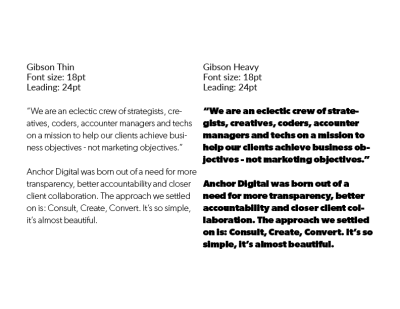
Many stakeholders believe that cramming more text “above the fold” increases value. Data proves the opposite. Proper typography, specifically line spacing (leading) and paragraph width, can increase content comprehension and reading speed by up to 20%.
Optimal line height (generally 1.5x the font size) reduces “visual noise,” allowing the brain to process information with less cognitive effort. When users struggle to read your text due to tight spacing or small fonts, their “perceived effort” increases, leading to a higher bounce rate. Legibility is a conversion tool: if it’s hard to read, it’s hard to buy.
There are many ways to display more legible text. For example, if line spacing (leading) is too small or the font is too heavy, this also impacts readability.
8. Your Users Only Read 20% of Your Content
This truth meshes well with the previous one. Users do not read your website; they scan it. On a typical web page, users read only about 20% to 28% of the text.
Because modern users scan in an F-pattern or Spotted pattern, designing for reading is a tactical error. We must design for scanning.
This requires the following:
- Bold headers that narrate the value proposition.
- Bullet points for key benefits.
- White space to connect users to key information (discussed in the previous truth).
- High-contrast call-to-action (CTA) buttons. If your core message is buried in a paragraph, it is invisible to nearly 80% of your audience.
9. Why User Testing With 5 People Is the Magic Number
I have heard of companies that waste six-figure budgets on massive user studies with 100 people, only to get buried in noise. The reality is that testing with just 5 users typically uncovers 85% of usability problems.
This is a mathematical sweet spot. After the fifth user, you reach the point of diminishing returns — you spend more money to find fewer new bugs. The competitive advantage belongs to small and frequent user testing activities. Test with 5 people, iterate, and test with 5 more. It is the most cost-effective way to build a bulletproof product.
Personally, I have followed this guideline many times during user testing activities, and I can confidently say that testing with 5 people does deliver the majority of issues in your design.
10. The Financial ROI of 9,900%
Last, but definitely not least, the most staggering statistic in our industry remains consistent. On average, every $1 invested in UX returns $100. This 9,900% ROI isn’t magic, but the sum of increased conversion and reduced support.
A fully optimised UX design can improve conversion rates by up to 400%. Furthermore, intuitive design significantly lowers customer support requirements. When a product is self-explanatory, you don’t need a massive call centre to explain how to use it.
The Depth of UX Investment
Beyond these individual statistics, we must address the cumulative effect of a mature UX practice. In my years of practising, the most successful firms are those that treat UX as a continuous improvement loop rather than a one-off project. The data shows that companies with high design maturity see 32% higher revenue growth and 56% higher total returns to shareholders compared to their less design-focused peers.
This discrepancy exists because mature UX organisations move beyond “user delight” and into “user efficiency.” When you shave 30 seconds off a workflow for a team of 1,000 employees, you aren’t just making them happier; you are reclaiming hundreds of thousands of dollars in annual productivity. This internal ROI is often overlooked, but it is just as vital as consumer-facing conversion rates.
Furthermore, the “experience gap” is real. 80% of companies believe they deliver a “superior experience,” but only 8% of customers agree. This massive disconnect represents a significant market opportunity for those willing to look at the hard data. By bridging this gap through continuous user testing and performance optimisation, you aren’t just improving a product but capturing market share that your competitors are leaving on the table.
The Impact of AI
Today, we cannot talk about UX without talking about AI. However, AI hasn’t replaced these 10 facts, but it has accelerated the solution on some of these.
- Agentic UX
60% of designers are now building “AI agents” that take actions on behalf of the user, drastically reducing the impact of Hick’s Law by narrowing down choices before the user even sees them. - Real-Time Personalisation
32% of teams use AI to personalise interfaces in real-time, meaning the F-Pattern scanning habits are catered to by moving the most relevant content to exactly where that specific user’s eyes are likely to land. - Automated ROI
93% of designers are using generative AI tools to prototype faster, which brings the 1:100 Cost Ratio even lower by allowing us to find and fix errors before a single line of production code is written.
AI has turned UX from a static map into a living, breathing guide for users. But the fundamental rules of human psychology, such as our 50ms judgments and our need for white space, remain unchanged.
Conclusion
In summary, here is a list of the key truths to remember:
- Fixing issues in the design phase is 100 times cheaper.
- Performance impacts user experience.
- Your site has 50 milliseconds to impress your customers.
- Hick’s Law: The cost of overwhelm.
- White space improves comprehension.
- The power of “fake” progress.
- Make your content readable.
- Your users only read 20% of your content.
- Why user testing with 5 people is the magic number.
- The financial ROI of 9,900%.
As we move deeper into the late 2020s, the line between “design” and “business strategy” has vanished. The data is in, and companies that lead in design outperform their competitors by 1.7x in revenue growth.
UX design is no longer a team you hire to “make things look nice.” It is the research-driven, data-backed discipline that ensures your digital product isn’t just a cost centre, but a revenue-generating machine.
In fact, this has always been the case, but I hope that in presenting these cold, hard truths, it now becomes a reality for your business.
As I have found over the years, implementing factual design improvements does make a difference that intuition alone can’t replicate. We are past the era of subjective opinions. The data is clear, the psychology is proven, and the ROI is undeniable. The only question left is whether you’re ready to let the facts lead your design, or if you’ll let your competitors do it first.

(yk)